
Written by Lilly Thies, Class of 2026
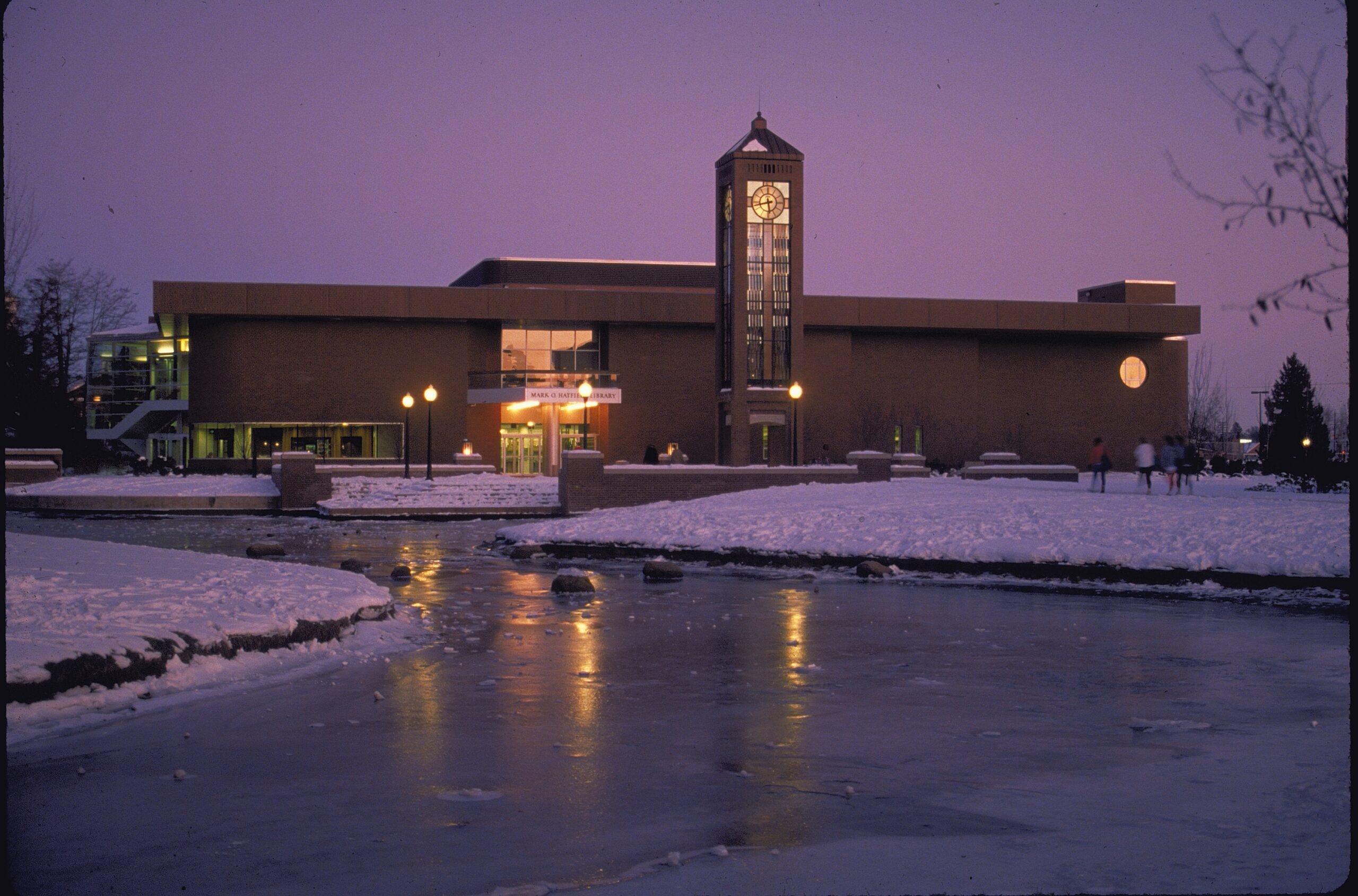
One of the most picturesque views of Willamette’s campus is the gentle curve of the gurgling Mill Stream as it makes its way under the bridge from Jackson Plaza to the quadrangle area of campus, with the hulking structure of Mark O. Hatfield Library and the statuesque Whipple Clock Tower standing guard. On sunny days, students lounge on the low stone walls of the Plaza to soak up Vitamin D, and campus tours are certain to stop by the bronze seal, reminding prospective students not to step on it (lest they fail their finals!) and explaining the campus motto: “Not unto ourselves alone are we born.”

September 4, 2026 marks the fortieth anniversary of the dedication of Mark O. Hatfield Library and its installation as the centerpiece of modern campus life. The library’s debut shifted Willamette’s symbolic center of gravity from the quad and the “old row” of Eaton, Waller, and Gatke to focus on the new technologies of learning as exemplified by the new library.
The library at Willamette has had a few homes since the University’s establishment in 1842. Its first was on the second floor of Waller Hall, Willamette’s first building. However, the expanding student population and their accompanying reading demands soon outgrew the small space, so a new building, designed by renowned architect Pietro Belluschi, was dedicated on May 7, 1938.1 This same building remained Willamette’s primary library for nearly fifty years.
An expansion project for the then-outdated University Library was conceptualized in 1965, with the target for completion set for 1972. According to a fundraising brochure from 1965, “The new library addition will more than double the size of the present building and triple the current storage facilities… The new space will also expand the periodicals room and add new cataloging and order department quarters, plus new seminar rooms and new storage space for valuable collections.”2 This addition to the original library building, dedicated May 20, 1967, cost $626,000 and added Walton Hall onto what is now known as Smullin Hall. Though the addition was successful in expanding the library’s storage capabilities, it was only a temporary fix– the building’s new layout was confusing and the atmosphere by all accounts generally uninviting.
Enter Patricia Stockton, University Librarian hired from American University in 1975 to fill the years-vacant position. Under her leadership, she implemented a suggestion box for students to voice their concerns and needs regarding the library, consolidated the library’s collection of microfilm, created an inventory of periodicals, relocated the circulation desk to better serve students, and converted the entire collection from the Dewey Decimal system to the Library of Congress Catalog system.3 The Collegian reports that Stockton “visited every department head on campus, talked with numerous students (she lived in Lausanne for a while), attended the budget hearings and has become involved with the academic process to determine who uses the library, what the needs are, how to go about making changes and what there is to work with.”4 Over the five years of Stockton’s tenure at Willamette, she was instrumental in the conceptualization of the new library building.
Professor Ralph Ellsworth, a “world-renowned authority on library architecture and organization” was brought in by the University and library staff to assess the possibility of remodeling and expanding the existing library building. In his assessment, he outlined issues such as having little room in the multi-tier book stacks for students to study and collaborate, low ceilings, poor lighting (students cited a droning buzz unconducive to focus), a lack of ventilation, and great fire hazard. In addition to this, because of the confusing layout of the building, it was difficult to logically locate books. The bookshelves themselves were load-bearing in some areas, supporting the sagging ceiling above.5 Additionally, the Music department and the Graduate School of Administration (now Atkinson Graduate School of Management) had separate libraries, which led to inconsistency with each collection’s hours, the need to staff multiple library spaces, and costly and unnecessary duplication of materials.6 A centralized library building would remedy these issues.
With all of these factors considered, along with the cost of remodel, Ellsworth suggested constructing a new centralized library of around 42,000 square feet that would include multimedia collections and accommodate the University’s growing collection and student population.7 This new library would be the most ambitious part of Willamette’s ongoing $18 million Capital Campaign project aimed at modernizing outdated university buildings such as Waller, Collins, and Eaton halls.8
In May 1978, University President Robert Lisensky appointed an ad hoc library committee, which distributed questionnaires about library needs and current use to students and faculty members and held hearings regarding these issues through the end of the year. In March 1979, the findings were presented to the Executive Committee of the University Board of Trustees, and President Lisensky requested and received authority to select an architect and obtain schematics for a new or remodeled building. Later that year, the president appointed a subsequent library building committee– composed of members from the faculty, administration, Board of Trustees and library staff– to help select an architect and review library plans. Four architectural firms were invited to campus in May and advised the committee, in line with Ellsworth’s previous recommendation, that remodeling would be too costly and that the construction of a new building should take precedence. The next step was to choose an architect. Eventually, in June 1979, Ted Wofford of the Murphy, Downey, Wofford and Richmond Architectural Firm in St. Louis was selected, and soon after, his schematics were approved by the Library Committee to be presented to the Board of Trustees.9
Over the next five years, the library plan was in constant revision between Wofford and Librarian Pat Stockton– who wrote a nearly eighty-page program statement for the library– as well as her successors, Charles Weyant (appointed 1981) and Sandy Weronko (appointed 1984). The delay between the initial plan for the library and the beginning of construction was partially due to difficulty in gaining funding for the project. Both President Lisensky and the newly appointed President Jerry Hudson had applied for multiple Olin Grants (which could fund an entire building due to the large size of the endowment), but were unsuccessful, leading Hudson and the Board of Trustees to adopt a new strategy– naming the library after Senator, notable alumnus, and former professor Mark O. Hatfield. The library would also act as a depository for Hatfield’s papers, political memorabilia, and books, which would be stored in the aptly-named Hatfield room on the second floor. As President Hudson noted, “the presence of [Hatfield’s] papers gives historic significance and greater importance to the entire project and sets it apart for foundation funding.”10 Indeed, following the announcement of the library as a depository, large gifts rolled in from the Fred Meyer Trust, the Murdock Charitable Trust, the Kresge Foundation, the Collins Foundation, Grace Goudy, and the Atkinson Foundation. Full funding for the library project was finally secured, and ground was broken in April 1985.

Plans for the library initially included a full-size auditorium, which was scrapped due to a need to save money and the existence of other similar spaces on campus. The Hatfield Room, originally designed to seat 150, met the need for a larger space to congregate. Interestingly, in preliminary plans, the library is situated where Goudy Commons sits today, west of Smith Auditorium and south of the Doney/Lausanne complex. However, it was relocated to its current location between the University Center and the Sparks Center to better unify the two existing buildings’ modern, boxy constructions and create a clearer entrance point to the campus.11 One feature that remained through every iteration of the plan was the 24-hour study space, lovingly referred to as “The Fishbowl” by the campus community in reference to its wall of windows. Sandy Weronko, University Librarian at the time of the library’s construction, noted student desire for an alternate type of reader space, one that was less restrictive than the typical noiseless library atmosphere, as well as one where students could eat, drink, and even smoke. She also stated that 24-hour access would allow students to study outside their residence and have a place to work late into the night without disturbing roommates.12

According to Wofford, the architecural goal was to“achieve optimum functional relationships in the interior and house this necessarily large block of space in a structure which blends with its neighbors without imitation or pretension, recognizes and reinforces human scale through the articulation outfits masses and patterns of its fenestration, strengthens the much needed sense of entry and form for the overall campus and, by its transparency and relationship to the Millrace, allows the lovely landscape to participate in and dominate the building and the user’s experience of it.”13 The transparent facades on the north and south “allow a visual link between the north and south sections of the campus” and also allow light to penetrate the interior of the building and filter through north-south facing stacks. William F. Willingham notes that “the architect uses red-brown brick to harmonize with the brickwork of adjacent structures,” while “expanses of glass and trim of bright metal serve to lighten the effect of the building’s mass.”14 The St. Louis Business Journal notes that Wofford’s designs tend to include “open staircases surrounded by glass so that people do not get disoriented as they move from floor to floor.”15 This detail is included in the staircase to the right of the circulation desk, which overlooks the Mill Stream and the bridge crossing it.
The Hatfield Library was designed with the future in mind. The most obvious of these goals is the structure provided by the library and its accompanying plaza in creating a sense of “entry and form” for the campus as one approaches from the Sparks parking lot.16 The structure was also designed to be able to add a third floor in the future to accommodate future library acquisitions and campus needs. A 1985 edition of The Collegian notes that the new design plans for “rapid and efficient adaptation of library facilities to accommodate information technology advancements expected to occur in the next decade.”17 To emphasize the technological advancement the new library would allow, the library staff implemented the “Inlex System,” also known as the ONLINE Catalogue, which equipped each book with a unique barcode to fully automate circulation and allow for easier research. Notably, Willamette became the first academic library in the Pacific Northwest to achieve this level of automation– putting a new spin on Willamette’s oft-used tagline “First in the West.”18
After the library’s construction was complete, the library staff sent out a call to alumni, faculty, and students to help move books by the armful or cartful from the old library to the new. Staff from other libraries around the region were also invited to tour the Mark O. Hatfield library before it was open to the public.19

The official dedication ceremony was held on September 4th, 1986, and was well-attended by the Willamette community as well as some guests of honor, including Senator Hatfield and Librarian of Congress Daniel J. Boorstin.20 The ceremony included dedication addresses by Boorstin and Hatfield, the sealing of a time capsule under the Whipple Clock Tower, and an open house-style reception in the library. Hatfield’s speech emphasized the importance of spaces for learning, lamenting the huge discrepancy in national budget allotted to defense versus public libraries.21 Not much is known about the Clock Tower time capsule– it isn’t even mentioned in the dedication program– but it is set for opening in 2086.
The final construction of the library boasted 63,000 square feet with room to house 250,000 volumes and included space for 450-500 users at any given time, a far cry from the previous library’s 25,000 square foot footprint and 143,000 volume capacity.

The appeal of the library and the increase in usage was immediately apparent, according to University Librarian Sandy Weronko: “Our use has increased dramatically, an 83% increase the first year in the new building. We now average about 1000 people in the library daily during the academic year, as compared with a previous daily average of 200-250.”22 Weronko also notes the shifting of campus culture as a result of the new building: “The library has now become the true center of the campus. It is the place students meet, study and write letters as well as do research… Visitors always comment on two things: how light, spacious, friendly and comfortable the building seems, and how many people are in the building– even on sunny afternoons. And that’s the true test of success for a library building.”23
True to its mission of technology and progress, the Hatfield Library has continued to adapt to the changing needs of students and faculty alike. While microfilm readers still exist, computer monitors now occupy some of the carrels on each floor, and many are left empty to allow space for laptops. Older print journals have since been relocated to offsite storage to incorporate more student space, and the library is now dotted with well-maintained houseplants. Display cases on both floors allow the Archives or the Hallie Ford Museum of Art to showcase their collections. The Willamette Archives, previously pressed for space in their joint processing and reading room, expanded into the Hatfield Room to create a beautiful dedicated space for researchers as well as an easily convertible venue for presentations, and lectures. In 2004, new Librarian offices were constructed to allow for better access to reference librarians and integrate them into the main space. The modular, open space of the library allows for consistent updates to occur as technology advances and needs change.24
Even after 40 years, the Mark O. Hatfield Library remains one of the true hubs of campus– a space where students can be seen having group project meetings, scribbling notes on rolling whiteboards, hunching over readings late into the night, or leaving with a huge stack of books for their senior thesis. Not only is it a space for academics, but it is also a space where students chat with their friends across the circulation desk, enjoy the rare Oregon sunshine beaming through huge windows, or destress while doing a puzzle. The Hatfield Library’s continuing role in campus life, is a testament to the power of intentional, forward-looking architectural design and the importance of a building’s atmosphere in encouraging and cultivating a lasting love of learning and physical media.
Endnotes
Click to expand
- University Library Dedication, 1938 May 7, Box: 3, Folder 50, Willamette University Library records, WUA129, Willamette University Archives and Special Collections, https://willamette.libraryhost.com/repositories/2/archival_objects/88708, Accessed May 26, 2026.
- Library expansion fundraising brochure, circa 1965, Box: 3, Folder 51, Willamette University Library records, WUA129. Willamette University Archives and Special Collections. https://willamette.libraryhost.com/repositories/2/archival_objects/88709 Accessed May 26, 2026.
- Anne Pfister, “Checking out the library,” Willamette Collegian, 9 September 1976, https://hdl.handle.net/10177/7935.
- Cheryl Wheeler, “Pat Stockton sees library changes,” Willamette Collegian, 20 November 1975, https://hdl.handle.net/10177/8810.
- Building planning: correspondence with Ralph Ellsworth, architecture consultant, 1977-1980, Box: 3, Folder: 54. Willamette University Library records, WUA129. Willamette University Archives and Special Collections. https://willamette.libraryhost.com/repositories/2/archival_objects/88712 Accessed May 26, 2026.
- Building Program Statement, 1980 April, Box: 3, Folder: 57. Willamette University Library records, WUA129. Willamette University Archives and Special Collections. https://willamette.libraryhost.com/repositories/2/archival_objects/88715 Accessed May 26, 2026.
- Building Program Statement, 1980 April, Box: 3, Folder: 57. Willamette University Library records, WUA129. Willamette University Archives and Special Collections. https://willamette.libraryhost.com/repositories/2/archival_objects/88715 Accessed May 26, 2026.
- Nelson, Gary E. “Building Renovation Plans for WU.” Willamette Collegian, 31 January 1980. https://hdl.handle.net/10177/7634.
- Building planning: Comments and correspondence, 1982-1985, Box: 3, Folder: 62. Willamette University Library records, WUA129. Willamette University Archives and Special Collections. https://willamette.libraryhost.com/repositories/2/archival_objects/88720 Accessed May 26, 2026.
- William F. Willingham, Collegiate Architecture and Landscapes in the West: Willamette University 1842-2012, Hallie Ford Museum of Art, 2019, 172.
- Willingham, Collegiate Architecture and Landscapes in the West, 162.
- Building planning: Comments and correspondence, 1982-1985, Box: 3, Folder: 62. Willamette University Library records, WUA129. Willamette University Archives and Special Collections. https://willamette.libraryhost.com/repositories/2/archival_objects/88720 Accessed May 26, 2026.
- William F. Willingham, Collegiate Architecture and Landscapes in the West: Willamette University 1842-2012, Hallie Ford Museum of Art, 2019, 169.
- Willingham, Collegiate Architecture and Landscapes in the West, 170.
- Grover Cleveland, “Firm designs by the book for libraries nationwide,” St Louis Business Journal, 9-15 February.
- William F. Willingham, Collegiate Architecture and Landscapes in the West: Willamette University 1842-2012, Hallie Ford Museum of Art, 2019, 169.
- Jon Radmacher, “Trustees approve plans for Hatfield Library: construction to begin this spring,” Willamette Collegian, 8 February 1985, https://hdl.handle.net/10177/9211.
- Bueford Hemingway, “ONLINE makes it fast and simple,” Willamette Collegian, 6 October 1986, https://hdl.handle.net/10177/10177.
- Building planning: publicity, 1985-1986, Box: 4, Folder: 2. Willamette University Library records, WUA129. Willamette University Archives and Special Collections. https://willamette.libraryhost.com/repositories/2/archival_objects/88724 Accessed May 27, 2026.
- Building planning: publicity, 1985-1986, Box: 4, Folder: 2. Willamette University Library records, WUA129. Willamette University Archives and Special Collections. https://willamette.libraryhost.com/repositories/2/archival_objects/88724 Accessed May 27, 2026.
- Building planning: publicity, 1985-1986, Box: 4, Folder: 2. Willamette University Library records, WUA129. Willamette University Archives and Special Collections. https://willamette.libraryhost.com/repositories/2/archival_objects/88724 Accessed May 27, 2026.
- Building planning: correspondence with Ted Wofford, architect, 1978-1991, Box: 3, Folder: 55. Willamette University Library records, WUA129. Willamette University Archives and Special Collections. https://willamette.libraryhost.com/repositories/2/archival_objects/88713 Accessed May 26, 2026.
- Building planning: correspondence with Ted Wofford, architect, 1978-1991, Box: 3, Folder: 55. Willamette University Library records, WUA129. Willamette University Archives and Special Collections. https://willamette.libraryhost.com/repositories/2/archival_objects/88713 Accessed May 26, 2026.
- Librarian office construction plans, 2004 July-August, Box: 4, Folder: 14. Willamette University Library records, WUA129. Willamette University Archives and Special Collections. https://willamette.libraryhost.com/repositories/2/archival_objects/88723 Accessed May 27, 2026.
Works Referenced
Click to expand
- Arends Jr., Lewis H. “WU Trustees Approve Plans for Library.” Statesman Journal (Salem, OR), 27 January 1985.
- Cleveland, Grover. “Firm designs by the book for libraries nationwide.” St Louis Business Journal, 9-15 February.
- Green, Mark T. “Senate passes Bistro.” Willamette Collegian, 21 February 1986. https://hdl.handle.net/10177/10641.
- Hemingway, Bueford. “ONLINE makes it fast and simple.” Willamette Collegian, 6 October 1986. https://hdl.handle.net/10177/10177.
- Nelson, Gary E. “Building Renovation Plans for WU.” Willamette Collegian, 31 January 1980. https://hdl.handle.net/10177/7634.
- Pfister, Anne. “Checking out the library.” Willamette Collegian, 9 September 1976. https://hdl.handle.net/10177/7935.
- Radmacher, Jon. “Trustees approve plans for Hatfield Library: construction to begin this spring.” Willamette Collegian, 8 February 1985. https://hdl.handle.net/10177/9211.
- Wheeler, Cheryl. “Pat Stockton sees library changes.” Willamette Collegian, 20 November 1975. https://hdl.handle.net/10177/8810.
- Willamette University Facilities Management Records, WUA 130. Willamette University Archives and Special Collections, Salem, OR.
- Willamette University Library Records, WUA129. Willamette University Archives and Special Collections, Salem, OR.
- Willingham, William F. Collegiate Architecture and Landscapes in the West: Willamette University 1842-2012. Hallie Ford Museum of Art at Willamette University, 2019
Image Citations
Click to expand
- “Mark O. Hatfield Library in snow.” 2002. Willamette University Campus Photograph Collection. https://hdl.handle.net/10177/41559.
- “Millstream and Mark O. Hatfield Library on a sunny day.” 2008. Willamette University Campus Photograph Collection. https://hdl.handle.net/10177/41561.
- “University Library.” 1950. Dr. Helen Pearce Collection. https://hdl.handle.net/10177/16837.
- “Studying in the University Library.” 1982. Willamette University Campus Photograph Collection.”University Library.” 1950. Dr. Helen Pearce Collection. https://hdl.handle.net/10177/25003.
- “Bob Packwood, Mark O. Hatfield, Jerry Hudson at Hatfield Library Groundbreaking.” 1985. Willamette University Campus Photograph Collection. https://hdl.handle.net/10177/41560.
- Building planning: correspondence with Ted Wofford, architect, 1978-1991, Box: 3, Folder: 55. Willamette University Library records, WUA129. Willamette University Archives and Special Collections. https://willamette.libraryhost.com/repositories/2/archival_objects/88713. Accessed May 26, 2026.
- “Construction outside Hatfield Library, Metalworker welding.” 1986. Willamette University Campus Photograph Collection. https://hdl.handle.net/10177/24823.
- Library Move Invitation, 1986. Box: 4, Folder: 2. Willamette University Library records, WUA129. Willamette University Archives and Special Collections. https://willamette.libraryhost.com/repositories/2/archival_objects/88724. Accessed May 27, 2026.
- “Mark O. Hatfield Library Dedication Ceremony, from the roof of the Fine Arts Building.” 1986. Willamette University Campus Photograph Collection. https://hdl.handle.net/10177/24757.
- “Hatfield Library, from Mill Street.” 1986. Willamette University Campus Photograph Collection. https://hdl.handle.net/10177/24774.
- “Library Staff.” 1987. Wallulah (Student Yearbook) Collection. Willamette University Archives. https://hdl.handle.net/10177/11864.