
Written by Savanah Anderson, Class of 2028
As the “Oldest in the West,” Willamette University features a historical campus, housing several buildings that have stood for over a century. These include Waller Hall, the oldest existing building on campus. This structure and the many others surrounding it are testaments to the early beginnings of Willamette University, its growth, and, its resilience. Over the course of its history, the university experienced fires damage to Waller Hall (formerly known as University Hall) and its predecessor the Oregon Institute. Although destructive and at times disastrous, the subsequent rebuilding efforts provided new opportunities for growth, helping to establish the university as a prominent institution in Salem.
The first major fire on campus consumed the founding building of Willamette University. The original structure on the site was built by Methodist missionaries to serve as an Indian Manual Labor School. After the labor school’s closure, the building was repurposed in 1842 and served as a school for Willamette Valley settlers.1 Named the Oregon Institute, “The Greek Revival styled, three-story school building was the most imposing structure of its kind in the Pacific Northwest,” intending to draw settlers to the area.2 By 1853, a demand for higher education emerged and a charter for Willamette University (then called “Wallamet University”) was granted. At this point, the Institute Building began hosting collegiate classes.3
By the 1860s, however, the building had begun to show signs of age and decay, quickly becoming unfit to house the growing student body. Consequently, plans were made to construct a new university building.1 Although this more spacious and practical structure was completed in 1864,4 the Oregon Institute building continued to hold classes until it burned down in 1872.5 Little is known about the cause of this fire. Some sources claim it was caused by arson,6 but this appears to be a rumor started by students, among whom “there was no possible reconciliation of their opinions concerning the guilty parties.”7 While the loss of the building was unfortunate, it had already become unserviceable. Its destruction forced the university trustees to focus their attention on the new University Hall, an effort which would benefit the university for decades to come.
The establishment of University Hall was ambitious given the conditions of early Oregon settlements, positioning Willamette University as a beacon of development in Western Oregon. This project proved challenging as Willamette University was young and underfunded. Generating enough revenue to construct a stately four-story brick building seemed nearly impossible. Yet, in four years, enough money had been raised to begin construction, thanks to the efforts of Reverend Alvin Waller.5 These funds would not cover the total cost of the building, however, leaving the university in debt after its completion.
University Hall opened for classes in 1867, four years after construction began.6 To prevent a recurrence of the fate of the Oregon Institute building, University Hall was constructed with bricks sourced from and fired at the construction site.7 Known to students as the “Old Historic Temple,” University Hall held classrooms, literary societies, and casual meeting spaces for students and faculty.8 In addition to being a gathering place, the building became a symbol of the school, attracting attention with its impressive size and collegiate, Greek Revival architecture.
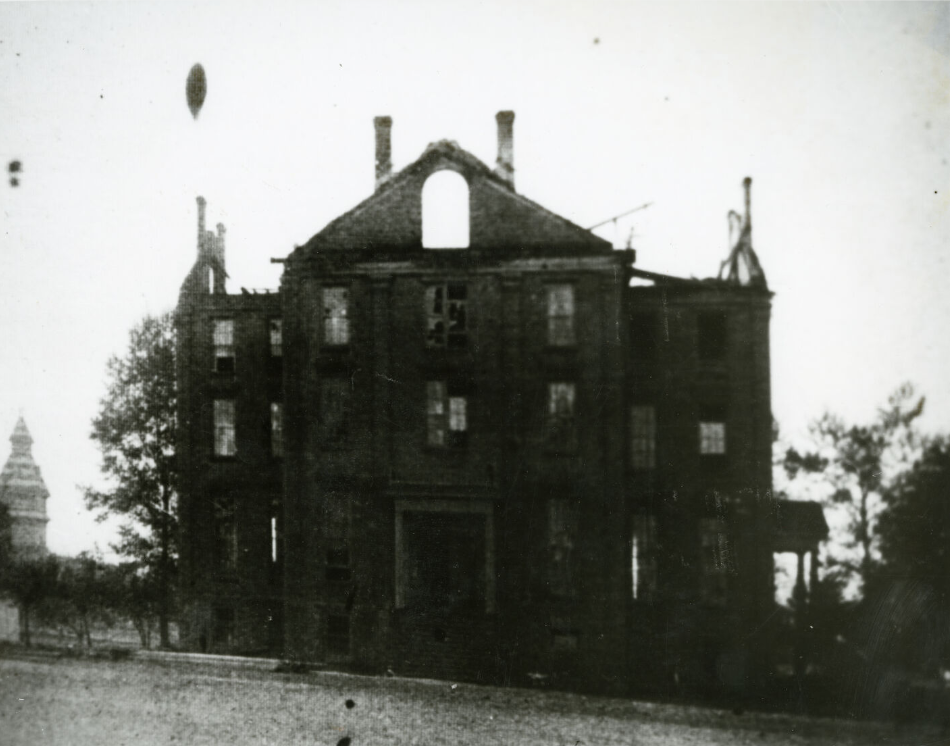
This status nearly came to an end on September 16, 1891, when a fire again damaged University Hall. The roof and upper floors were destroyed while the first floor sustained water damage due to firefighting efforts and exposure to rain.9 Recovery would require intensive outreach and fundraising, as well as an almost complete reconstruction of the upper parts of the building. Due to the establishment of a competing institution (Portland University), a decline in enrollment, and the cost of constructing the new Medical College in Portland, Willamette University was now $24,000 in debt.10 This loss was challenging, especially considering the difficulty the university had in funding the building’s original construction twenty-four years earlier.
To the pastoral community of Salem, news of the destruction of University Hall spread as rapidly as the fire itself. Crowds of students and residents of Salem gathered to witness the building’s burning. As Salem was primarily a Methodist settlement, the residents viewed the Methodist university as a worthy cause to support and contributed generously. In the words of university president Reverend George Whitaker: “Near friends probably were never so numerous or warmer than now.”11 And thus, the Salem community gathered together to help Willamette recover.
The Old Historic Temple, newly renovated thanks to the Salem community’s donations, added “eight session rooms, [a] chemical laboratory, a philosophical apparative, and two offices.”12 An additional change to the layout of the University Hall was made : after the fire, it was rebuilt in a mansard style, creating enough space to add a fifth floor to the building. A square, Victorian-styled tower was later added to this roof to replace the old cupola.
”
In 1912, University Hall was renamed Waller Hall in honor of Reverend Alvin Waller for his unyielding efforts to fund the campus’s growth.13 The building endured another challenge , however, when a second fire nearly destroyed the building. The source of the fire is unknown, as was the case for the 1891 fire. The second, third, and fourth floors of Waller Hall were badly damaged, although the exterior walls and first floor were left largely unscathed. The damaged floors previously housed the men’s dormitories, the chemistry department, and meeting halls for literary societies, the latter of which had now lost their meeting space to fire for a second time.14
Although Willamette was on much more stable financial footing than it had been during the 1891 fire, destruction of the building for the second time created a significant financial strain and caused discussion among the board of trustees about whether to repair and renovate or to entirely reconstruct Waller Hall.15 Ultimately, the decision was made to repair the building using its original walls and foundations, which had withstood both disasters thanks to the skill of the original planning and construction. Waller Hall was reconstructed in the year following the fire.16 In accordance with its original design, the mansard roof was scrapped and the original revival-style cupola returned, the very same tower that looms over campus today. The hall was renovated again in 1980. The current building still stands on its original foundation,17 enduring every trial to remain a prominent fixture of the university.
“The fire hath singed thee Willamette
Thy foes hath smote thee Willamette
Thy God hath blessed thee Willamette
Good men will bless thee too.”
–A Song for Old Willamette18
In an annual address to the board of trustees the year after the first University Hall fire, President Whitaker proudly stated:
“Other buildings will follow and we shall move on— steadily on.”19
He was right. Construction of Eaton Hall was completed in 1909, establishing an elegant, eye-catching monument in Salem and what is now the fourth oldest building on campus.20 Likewise, the Medical College (now the Art Building), and the now demolished School of Theology were both finished in 1906.21 The grand, Gothic-style women’s dormitory, Lausanne Hall ended construction in 1920.22 As Waller Hall recovered, so too did Willamette.
Waller Hall was placed on the National Register of Historic Places in 1975, when it was merely a century old; a recognition of the significance of this building. With care and maintenance Waller Hall will continue to stand as a symbol of Willamette University’s enduring legacy.
Endnotes
Click to expand
- Willingham, William F. 2019. Collegiate Architecture and Landscape in the West: Willamette University, 1842-2012. Corvallis: Hallie Ford Museum of Art, Willamette University, 20. ↩︎
- Ibid. ↩︎
- Gibby, Susan. 2016. “Willamette University.” Willamette Heritage. ↩︎
- Ibid, 28. ↩︎
- Gibby, “Willamette University.” ↩︎
- “Fire Blesses Willamette in Poverty,” Willamette Collegian, 16 February, 1951, 1. https://hdl.handle.net/10177/8480. ↩︎
- Gatke, M. Robert. 1943. Chronicles of Willamette. Portland: Binfords & Mort, 288. ↩︎
- Willingham, Collegiate Architecture and Landscape, 28-29. ↩︎
- Mabey, Kaylyn. 2017. “Waller Hall – 150 Years.” Willamette Heritage. ↩︎
- Willingham, Collegiate Architecture and Landscape, 28-29. ↩︎
- Mabey, “Waller Hall.” ↩︎
- Willingham, Collegiate Architecture and Landscape, 54. ↩︎
- “Editorial,” Willamette Collegian, 01 September, 1893, 5. https://hdl.handle.net/10177/8352. ↩︎
- “Annual Report of President to Board of Trustees”, 1892 June 14, Series II, Box: 2, Folder: 73. Willamette University Office of the President records, WUA006. Willamette University Archives and Special Collections. ↩︎
- Ibid. ↩︎
- Mabey, “Waller Hall.” ↩︎
- “Fire Destroys Main Portions of Old Temple,” 07 January, 1920, 1. https://hdl.handle.net/10177/10562. ↩︎
- Willingham, Collegiate Architecture and Landscape, 88. ↩︎
- Gibby, Willamette University. ↩︎
- Powers, D.W. and Robert K. Sutton, 1975. “Waller Hall,” National Register of Historic Places Inventory. ↩︎
- “A Song for Old Willamette,” Willamette Collegian, 01 October, 1891, 3. https://hdl.handle.net/10177/10195. ↩︎
- “Annual Report of President to Board of Trustees”, 1892 June 14, Series II, Box: 2, Folder: 73. Willamette University Office of the President records, WUA006. Willamette University Archives and Special Collections. ↩︎
- Kadas, Marianne, 1994. “Eaton Hall.” Oregon Historic Sites Database. ↩︎
- Willingham, Collegiate Architecture and Landscape, 74. ↩︎
- Ibid, 71. ↩︎
Image Citations
Click to expand
- “The Oregon Institute, undated,” Campus Photograph Collection, WUA9999, Willamette University Archives and Special Collections. https://hdl.handle.net/10177/26599.
- “Oregon Institute and Waller Hall in 1868, 1868,” Campus Photograph Collection, WUA9999, Willamette University Archives and Special Collections. https://hdl.handle.net/10177/25153.
- “Waller Hall, looking West after the 1891 fire, undated,” Campus Photograph Collection, WUA9999, Willamette University Archives and Special Collections. https://hdl.handle.net/10177/26498.
- “Crowd gathers around Waller Hall after 1891 fire, looking west, 1891 September,” Campus Photograph Collection, WUA9999, Willamette University Archives and Special Collections. https://hdl.handle.net/10177/26479.
- “Willamette University, Salem, Oregon, circa 1910,” Willamette University and Salem, Oregon Postcard Collection, WUA032, Willamette University Archives and Special Collections. https://hdl.handle.net/10177/12241.
- “Waller Hall after fire of December 17, 1919, 1919,” Ivan Corner ‘21 Willamette University Photographs, WUA020, Willamette University Archives and Special Collections. https://hdl.handle.net/10177/25145.
- “Interior of Waller Hall after 1919 fire, 1919,” Campus Photograph Collection, WUA9999, Willamette University Archives and Special Collections. https://hdl.handle.net/10177/25192.
- “Waller Hall – Gray’s Watercolor, undated,” Campus Photograph Collection, WUA9999, Willamette University Archives and Special Collections. https://hdl.handle.net/10177/26502.