
Written by Lilly Thies, Class of 2026
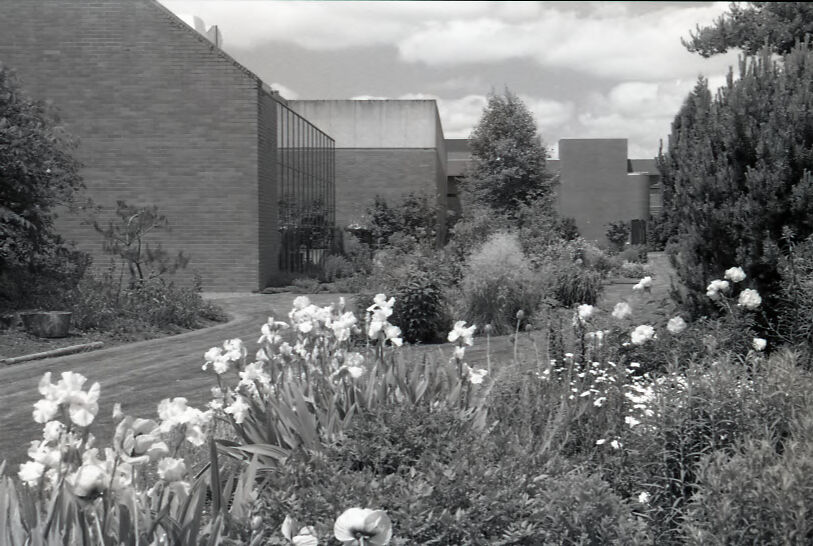
Tucked behind Sparks Athletic Center, The Martha Springer Botanical Garden is an idyllic yet easily overlooked corner of campus. Newly revitalized in Summer 2025, it is home to many species of interesting and beautiful plants, many of which are native to Oregon. The garden is a lush and shady green space, where the only ambient sounds come from a few gurgling fountains, the afternoon winds blowing through the trees, and hummingbirds cheerfully whizzing by– the perfect place to read, have lunch, or soak up the rare beams of Oregon sunshine. Not only is it relaxing, but it also has served as a living classroom encouraging community, botanical and biological learning, and environmental stewardship for nearly forty years.
“This is your garden… may you learn as you linger.”
The garden was dedicated in 1987 to beloved biology and botany professor Martha Springer, who taught at Willamette for thirty-four years before retiring in 1980. Dr. Springer, who was more often called “Ma Springer” for her lively disposition and wonderful home cooking, would often invite students to her house for fireside discussions. According to the Collegian article marking her retirement, she was “considered the matriarch of the school, and was asked to represent the female segment of the faculty on many issues.”1 Despite the small number of botany classes given at Willamette during her tenure, Dr. Springer’s enthusiasm and love for her field inspired more than a few students to pursue graduate studies in botany.2 She passed away in 1993, and asked that contributions be made to the Martha Springer Biology Scholarship Fund at Willamette in her honor.3
With its educational design, Springer Garden was conceptualized as a place for Willamette students to interact with and learn about the natural world. According to a 1999 Collegian article, the Springer garden was “the only place on campus where it [was] legal to pick flowers. Rather than being fined $50 a flower, students [were] encouraged to explore the gardens and pick their findings.”4 Alumnus Paul Boaden ‘77 remembers that there were name plates for the various different plantings, so that students and passerby could learn a little something while they relaxed in the garden.5
J. Wesley Sullivan of the Oregon Statesman stumbled upon the garden in the Summer of 1992, where he remarked upon the learning opportunities that the garden offered: “normally, we’d recognize a few [flowers] and wish we’d brought along our wildflower book to identify the rest. In this case, however, all the plants are labeled.”6 Sullivan reported the various facts he discovered on the name plates by merely walking through the garden: “In a rock garden, we found a label next to Dragon’s Blood Sedum informing us that the Romans grew gardens on their roofs to protect the buildings against lightning. In another bed, we discovered that iris means ‘eye of heaven.’”7. According to Professor David Craig, “the gardens ‘used to have raised beds with different kinds of educational plants and herbs which were related to classes, such as plants from Shakespeare plays for English classes.’”8
The garden was intentionally designed to encourage positive interactions with wildlife. A WU Grounds Department report notes that water features were created to appeal to birds, and various plants like California Lilac, Wallflower, Cow Poison, and Meadowfoam were selected to attract bees and butterflies. The design also included drought-resistant shrubs and perennials that would survive the warm Salem summers.9 Additionally, grounds staff eliminated the use of petroleum-based insecticides, herbicides, fungicides, and fertilizers in order to prevent pollution of the Mill Stream and increase environmental sustainability.10 In this way, the garden served as a celebration of both Willamette’s academic tradition and the diversity and resilience of Oregon’s native plants.
Elaine Joines became the garden’s first curator and caretaker after its opening in 1987, bringing extensive knowledge of plant biology, as well as a joyful demeanor, to the Springer Garden. Then-Chaplain Charlie Wallace described her as “an eccentric person; real vibrant, opinionated, talented.”11 Joines would often give garden tours to students throughout the year to appreciate the seasonal blooms.12 She remained the garden’s caretaker until she passed away in 1999, and is memorialized with a plaque in the garden that can still be seen today.
Over the years, the garden adapted and changed to serve the learning and development of the Salem community. Dean Wentworth, curator of the garden after Joines’ passing– and notably the first groundskeeper to begin feeding the Mill Stream ducks– offered “a full-time position” during the summer “for students to work in the garden with him,”13 allowing the campus community to get hands-on experience with grounds management and botany. Even children were welcome: In 2005, a group of biology undergrads led grade-school students and their parents on a field trip to the Springer Garden, where they “snipped flowers, leaves and stems that they then analyzed under microscopes in the lab.”14
Unfortunately, in 2021, an ice storm significantly damaged the garden’s trees and plants, and due to the COVID-19 pandemic restricting on-campus work, the garden became extremely overgrown and difficult to maintain.15 To the garden’s rescue came alumnus Paul Boaden, who decided to fund the Springer Garden revitalization project in memory of his late father, an avid gardener.16 Using Boaden’s generous unrestricted bequest, renovations began in early 2025, which included restoring water features, building a ramp for baby ducks, installing bee hotels, and putting in banana plants, along with re-sodding the area and constructing new seating areas.17 The revitalization also brought back Boaden’s beloved name plates, where students can scan a QR code connecting them to the app iNaturalist for more information on the various plantings.18 In the future, as the garden continues to thrive, there are further sustainability goals to be met, such as achieving the highest level of organic certification and eliminating the use of pesticides, employing more hand-weeding techniques instead.

Following the re-opening of the garden in June 2025, it is now common to see biology professors holding classes among the greenery, or students chatting on a stone bench on a sunny day. The garden’s enduring purpose can best be summed up by this poetic excerpt of its welcoming brochure from 1992: “The Garden welcomes you. It is here to teach you: to see the colors- loud and soft, pattern of light and shadow, texture of leaf and petal; to hear the whisper of the wind through the trees, the song of birds, the flutter of butterfly wings; to smell the scented air; to caress the fuzzy leaf, the silken petal; to open your mind and senses to nature/ This is your garden… may you learn as you linger.”19

Endnotes
Click to expand
- Julia Hungerford, “Ma Springer Retires After 34 Years,” Willamette Collegian, 13 November 1980, 4, https://hdl.handle.net/10177/8166.
- Ibid.
- “Martha E. Springer, Obituary,” Oregon Statesman, 2 December 1993, 14, https://www.newspapers.com/image/200132972/.
- Cannon-Marie Green, “Elaine Joines’ Garden,” Willamette Collegian, 18 November 1999, 3, https://hdl.handle.net/10177/9255.
- Maya Darski, “Honoring History and the Future Through the Martha Springer Garden’s Revitalization,” Willamette Collegian, 29 April 2025, https://www.willamettecollegian.com/post/honoring-history-and-the-future-through-the-martha-springer-garden-s-revitalization.
- J. Wesley Sullivan, “Botanical Gardens at Willamette Take Visitors by Surprise,” Oregon Statesman, 31 May 1992, 13, https://www.newspapers.com/image/201767172/.
- Ibid.
- Darski, “Honoring History and the Future.”
- Dean Wentworth, “Improving the Campus Landscape Organically,” WU Grounds Department, https://my.willamette.edu/site/facilities/pdf/dean-powerpoint.pdf.
- Ibid.
- Green, “Elaine Joines’ Garden,” 3.
- “Gardens on Display,” Willamette Collegian, 19 October 1989, 5, https://hdl.handle.net/10177/8663.
- Jeff Carlson, “In the Garden with Dean Wentworth,” Willamette Collegian, 9 March 2005, 5, https://hdl.handle.net/10177/7487.
- Katie Bruhn, “Kids Learn at WU, Too,” Willamette Collegian, 21 September 2005, 4. https://hdl.handle.net/10177/8860.
- Darski, “Honoring History and the Future.”
- Emily Gold Boutilier, “He Found a Home at Willamette. He’s Spent a Lifetime Giving Back,” Willamette University Newsroom, 29 September 2025, https://news.willamette.edu/library/2025/09/paul-boaden.html.
- Darski, “Honoring History and the Future.”
- Ibid.
Works Referenced
Click to expand
- Boutilier, Emily Gold. ““He Found a Home at Willamette. He’s Spent a Lifetime Giving Back.” Willamette University Newsroom, 29 September 2025, https://news.willamette.edu/library/2025/09/paul-boaden.html.
- Bruhn, Katie. “Kids Learn at WU, Too.” Willamette Collegian, 21 September 2005, 4. https://hdl.handle.net/10177/8860.
- Carlson, Jeff. “In the Garden with Dean Wentworth.” Willamette Collegian, 9 March 2005, 5. https://hdl.handle.net/10177/7487.
- Darski, Maya. “Honoring History and the Future Through the Martha Springer Garden’s Revitalization.” Willamette Collegian, 29 April 2025. https://www.willamettecollegian.com/post/honoring-history-and-the-future-through-the-martha-springer-garden-s-revitalization.
- “Gardens on Display.” Willamette Collegian, 19 October 1989, 5. https://hdl.handle.net/10177/8663.
- Green, Cannon-Marie. “Elaine Joines’ Garden.” Willamette Collegian, 18 November 1999, 3. https://hdl.handle.net/10177/9255.
- Hungerford, Julia. “Ma Springer Retires After 34 Years.” Willamette Collegian, 13 November 1980, 4. https://hdl.handle.net/10177/8166.
- “Martha E. Springer, Obituary.” Oregon Statesman, 2 December 1993, 14. https://www.newspapers.com/image/200132972/.
- Sullivan, J. Wesley. “Botanical Gardens at Willamette Take Visitors by Surprise.” Oregon Statesman, 31 May 1992, 13. https://www.newspapers.com/image/201767172/.
- Wentworth, Dean. “Improving the Campus Landscape Organically.” WU Grounds Department, https://my.willamette.edu/site/facilities/pdf/dean-powerpoint.pdf.
Image Citations
Click to expand
- Srivastav, Anushka. 2021. Photograph. Willamette Collegian. https://www.willamettecollegian.com/post/honoring-history-and-the-future-through-the-martha-springer-garden-s-revitalization.
- Szigeti, Sofie. A Glimpse of Greenery in the Martha Springer Garden. 3 October 2025. Photograph. Willamette Collegian. https://www.willamettecollegian.com/post/photojournalism-the-martha-springer-garden-sprung-back-to-life.