
Written by Lilly Thies, Class of 2026
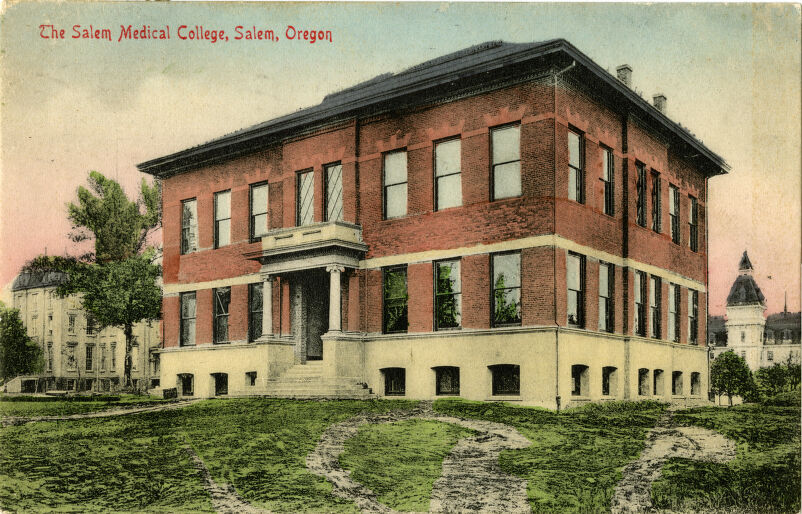
Willamette students are all aware of the stately red-brick Art building that stands on the Northwest corner of campus. Fewer, however, are aware that this same building once was home to the Willamette College of Medicine, a department which endured a rollercoaster of changes during its operation, whether it be faculty disputes, rival medical schools, moves between cities, near-bankruptcy, construction, falling windows, or its eventual absorption into the University of Oregon.
The Willamette University College of Medicine, the first medical school in the state of Oregon, opened in 1865 with 24 students.1 Classes, which notably included both men and women, were lectured by a faculty of primarily Salem physicians on the subjects of anatomy, chemistry, toxicology, surgery, and even medical jurisprudence.2 Classes were held in University Hall (now Waller Hall), which contained state-of-the-art facilities that rivaled those of Eastern universities, with fully equipped biology, chemistry, and microscopy labs, an attic reserved for dissection, and lockers for each student.3 One of the appeals of Willamette’s medical program was that it provided its students with many unique opportunities to practice their clinical skills, with the 1903 Wallulah citing the Florence Sanatorium, the Oregon State Insane Asylum (Now the Oregon State Hospital and Museum of Mental Health), the Salem Hospital, and the Chemawa Indian School’s Hospital as various sites for clinical experience.4 In the early 20th century, the school’s focus was on providing their students with practical skills, with the pedagogical focus on graduates being able to conduct procedures in case of emergency, rather than the mostly didactic focus of earlier decades.5
The Medical College experienced some financial and internal tension that impacted their abilities to operate, and in 1878 the decision was made to relocate the department to Portland in part to take advantage of the greater clinical facilities and additionally prevent a rival medical school from forming. Initially, classes took place in a rented livery stable, but in 1886, construction began for a new building residing on the corner of 14th and Couch in Portland.6 The new medical school was grand and ornamental, built in the high Victorian style with a large dissection auditorium seating 150 and a refrigerator that could house up to 30 cadavers.7

However, due to disagreements among the Willamette medical faculty, a rival medical school– affiliated with the University of Oregon– was started in Portland the same year by former Willamette professors. The competition between the schools led to a lack of clinical access for Willamette students and Portland no longer seemed to be the right place for the Medical College, and so in 1895, the college moved back to Salem. They were unable to move into the old building, as another department had moved in, so classes were held on rented off-campus sites.8
In 1905, the building as we know it today was constructed, with donations from the Medical College faculty as well as wealthy Salem residents such as prominent banker Asahel Bush. The building was to be “built of brick: be well ventilated and lighted, modern in every respect, with complete equipment”.9 After the construction of the new building, the school seemed to thrive, with incoming classes increasing nearly double between 1908 and 1911. However, trouble was on the horizon. In 1910, The Carnegie Foundation’s Flexner Report on Medical Education, which pushed for safety reforms in American medical schools, ranked Willamette a class C school (“severely deficient”), due to its poor clinical facilities.10 It became clear to the school that without an endowment or other financial help, the Medical program could not continue to operate. Therefore, the Board of Trustees voted to merge the Willamette Medical School with the publicly funded University of Oregon’s Medical School to allow their students to have access to better clinical facilities and equipment. In 1974, the school split from the University of Oregon to become its own institution, where it eventually adopted the name it holds today, Oregon Health & Sciences University (OHSU).
The original 1905 Medical College building has remained something of a campus legend, as it has gone through many iterations throughout its more than 120-year lifespan. After the school merged with the University of Oregon, the still-new building on Salem’s campus was converted to the Science Building –or “Chem Shack” as it was affectionately called by students–, and later into the Music Hall in 1941.11 In a 1970 edition of the Willamette Collegian newspaper, an article entitled “W.U. Music Hall Condemned” reports that the second and third floors were only suitable to be occupied by 1-2 people at a time, which prevented music classes from operating. The article also mentions a near-fatal incident in which a student in a practice room was nearly crushed by a 50-pound window which fell from the wall and shattered on the piano they were playing. Even eerier, the article contains an image of the pulley system and shaft used to transport cadavers, which were stored in the basement, up to the third floor dissection room.12 The first floor of the Music Hall remained in use in a partial capacity until 1977, when the building was renovated for the Art department, rendering the second and third floors habitable once again.13
Despite the turmoil the department endured during its 50 years of residence in Salem, the history of the first medical school in Oregon reflects trends in greater medical education in the United States and innovations in equipment, safety regulations, and shifts towards more practical, clinical pedagogy. Today, the Art building where students develop their film, stretch canvases, and roll ink onto hand-carved stamps may still have a slight scent of formaldehyde in the air, or a stain on the baseboards from a spilled science experiment, or even perhaps the faint echo of a sonata stuck somewhere in the vents. Whispers of the Medical College’s turbulent history still remain in the walls of the building, if you only know where to look.
Endnotes
Click to expand
- “Our Alma Mater,” 4.
- “New Affiliation Means Homecoming of Sorts for OHSU.”
- Wallulah 1906, 14.
- Wallulah 1903, 75.
- Wallulah 1903, 75.
- “New Affiliation Means Homecoming of Sorts for OHSU.”
- Collegiate Architecture and Landscapes in the West.
- “New Affiliation Means Homecoming of Sorts for OHSU.”
- “The Bulletin,” 11.
- Collegiate Architecture and Landscapes in the West, 77.
- “Remodelled ‘Chem Shack’ Now Housing College of Music,” 2.
- “W.U. Music Hall Condemned,” 8.
- “New Art Building Readied for Classes,” 4.
Works Referenced
Click to expand
- “New Art Building Readied for Classes.” Willamette Collegian, 2 September 1977, 4. https://hdl.handle.net/10177/10354. Accessed 12 August 2025.
- “Our Alma Mater.” Willamette Collegian, 19 January 1919, 4. https://hdl.handle.net/10177/9500. Accessed 12 August 2025.
- Pine, Kylie. “New Affiliation Means Homecoming of Sorts for OHSU.” Willamette Heritage Center, January 2, 2016. https://www.willametteheritage.org/ohsu-salem-history/. Accessed 13 August 2025.
- “Remodelled ‘Chem Shack’ Now Housing College of Music.” Willamette Collegian, 7 December 1956, 2. https://hdl.handle.net/10177/10557. Accessed 13 August 2025.
- “The Bulletin.” Willamette University, March 1905, 11. https://hdl.handle.net/10177/11976
- Wallulah 1903, Willamette University Digital Collections, Wallulah (Student Yearbook,) 1903, https://hdl.handle.net/10177/11848. Accessed August 11, 2025.
- Wallulah 1906, Willamette University Digital Collections, Wallulah (Student Yearbook,) 1906, https://hdl.handle.net/10177/11858. Accessed August 11, 2025.
- Willingham, William F. Collegiate Architecture and Landscapes in the West: Willamette University 1842-2012. Hallie Ford Museum of Art at Willamette University, 2019.
- “W.U. Music Hall Condemned.” Willamette Collegian, 1 May 1970, 8. https://hdl.handle.net/10177/7926. Accessed 12 August 2025.
Image Citations
Click to expand
- “Willamette University College of Medicine in Portland,” Campus Photograph Collection, WUA9999. Willamette University Archives and Special Collections. Box 1.
- “The Salem Medical College, Salem, Oregon,” 1900, Postcard Collection, WUA032. Willamette University Archives and Special Collections. https://hdl.handle.net/10177/12297.
- “Construction in the Art Building,” 1977, Campus Photograph Collection, WUA9999. Willamette University Archives and Special Collections. https://hdl.handle.net/10177/24236
- “Inside the Music Hall: Two Women Playing Violin and Piano,” Campus Photograph Collection, WUA9999. Willamette University Archives and Special Collections. https://hdl.handle.net/10177/24250
- “A Female Student Does an Experiment in Science Hall,” 1918, Campus Photograph Collection, WUA9999. Willamette University Archives and Special Collections. https://hdl.handle.net/10177/25456
- “Students on Steps of Music Hall,” Campus Photograph Collection, WUA9999. Willamette University Archives and Special Collections. https://hdl.handle.net/10177/24271