
Written by Savanah Anderson, Class of 2028
To most, Homecoming is a celebration for alumni consisting of a football game, a dance, and maybe the wearing of mums, as is the case for many universities and high schools. The Willamette students of decades past, however, had a different idea. A lot of different ideas. While most Homecoming traditions were phased out by the 1970s, during the preceding fifty years former students used competition to fuel a decades-long class rivalry and define what makes Willamette the unique university it is today. Though these traditions have since been discontinued, they were once a defining part of college life and a prime representation of school spirit. The following is a look at Willamette’s competitive Homecoming traditions from the early twentieth century, each more bizarre than the last, and all distinctly Willamette.
Bag Rush
In April of 1914, a simmering rivalry between the freshmen and sophomore men came to a head. After months of in-fighting, pranks, and a rising sense of unease on campus, committees from both classes met to agree on a way to release this pressure: a casual, competitive game. Known as the Bag Rush, this was a contest in which 12 men from each class would compete to carry two 25-pound sacks of sawdust across the football field. At the whistle, players charged three bags positioned at the midfield and attempted to carry them to their goal line. Once a bag crossed the goal line it was safe from the opposing team. The first team to carry two bags to their side of the field was the victor.1 This event was a chaotic free-for-all, “the only restriction being the unwritten law of all Willamette contests to play fair and leave out all the dirty work.”2
Beginning as a standalone tradition to be held in the fall of each year, the Bag Rush was incorporated into halftime of the Homecoming game for the first official Homecoming celebration in 1923.3 At its conception, this game may have seemed a safe, good-natured way to release tension but, unfortunately, it became combative in later years. In 1944 a player was hospitalized due to “severe contusions” as the result of a game reportedly turned violent.4 Although the student was expected to recover, as noted by a Collegian article, the incident caused the Bag Rush to be quickly abandoned and replaced by less dangerous traditions.
Freshman Bonfire
A staple of class pride and carefree revelry, Homecoming weekend hosted an annual raging bonfire in celebration of the newly admitted freshman class. The earliest mention of a freshman bonfire was in 1922, predating the first Homecoming,5 but this event became a part of the regular Homecoming traditions in 19236 and remained a part of the festivities until 1970. In preparation for the fire, the freshman class would gather tinder and scrap to construct enormous towers of kindling, thirty to forty feet high and carefully engineered with an elaborate system of flues to direct smoke upwards and maintain a steady blaze. This event was a proud display of Willamette students’ abilities, shooting up to fifty feet of flames.7 To prevent this structure from being prematurely lit and destroyed by the scheming sophomore class, the location of this bonfire was made a “secret” in 1958, and this confidentiality continued through the bonfire’s remaining years. Naturally, making the location a “secret” was about as revealing as announcing where it was, but this covertness, ironically, became a clever marketing tactic for the event.8 The Freshman Bonfire was officially cancelled in 1970, due to the dissolution of the Homecoming committee9 and the inability to secure a permit from the Salem Fire Department.10 While there is no trace of the event on campus today, it endures as a prominent piece of campus history.
Chariot Race
The spirit of competition continued with a co-ed twist. The first annual women’s freshman-versus-sophomore chariot race was held in 1931 during halftime of the Homecoming game,11 giving the women of Willamette a chance to join the revelry and prove their superiority over the competing class. The tradition appears to have been short-lived, however, as there is little to no mention of it past 1931. While brief, this was the first of the Homecoming competitions that not only allowed women to participate, but also placed them in the center of the entertainment. Regardless of the reason for this competition’s demise, this wouldn’t be the last time the women of Willamette brought something new to Homecoming weekend.
Freshman Leaf Rake
Lest the freshmen get too comfortable with their wins in the Bag Rush or Chariot Race, the Leaf Rake certainly reminded them of their social standing on campus. In a tradition starting as early as 1932,12 freshman boys would be awoken at dawn to begin raking the leaves on campus at the behest of the sophomore class.13 Although women were not expected to perform physical labor, as was the standard for the time, the freshmen girls did not escape this punishment. Instead, they would be tasked to prepare breakfast for the freshmen boys.14 The annual Leaf Rake seems to have declined around 1965, around the time Homecoming declined in popularity. This may have been due to a waning interest in school activities, or perhaps the lessening divide between underclassmen finally put the tradition to rest.
Whiskerino
In 1939, seeking “to pull the student body out of its present lethargy,”15 a student organized a club-sponsored, school-wide beard-growing contest. Beginning as a simple way to boost student morale on campus, the beard growing contest, known as the “Whiskerino,” became widely popular and eventually transitioned from Freshman Glee to Homecoming in 1953.16 Given the political and social climate of the era, the event was likely a rebellion against the clean-shaven look, mandated by the recent military draft. Participation was expected of all male students; and those who failed to produce an impressive beard or refused to participate would be subject to “severe ridicule,”17 “detrimental insignia,”18 “vigilante justice,”19 and the inevitable threat of a dunking in the Mill Stream. The winner, however, would receive some sort of prize including, in 1953, a free shave at a barber shop and a traveling shaving kit.20 Despite this contest’s initial popularity, the first Whiskerino to be associated with Homecoming was its last. The inclusion of the contest in the list of official Homecoming events in 1954 sparked significant controversy and protest from students, due in part to the pressure to participate.21 As a result, Whiskerino was discontinued in 1955 and was never revived.
Push-Ball
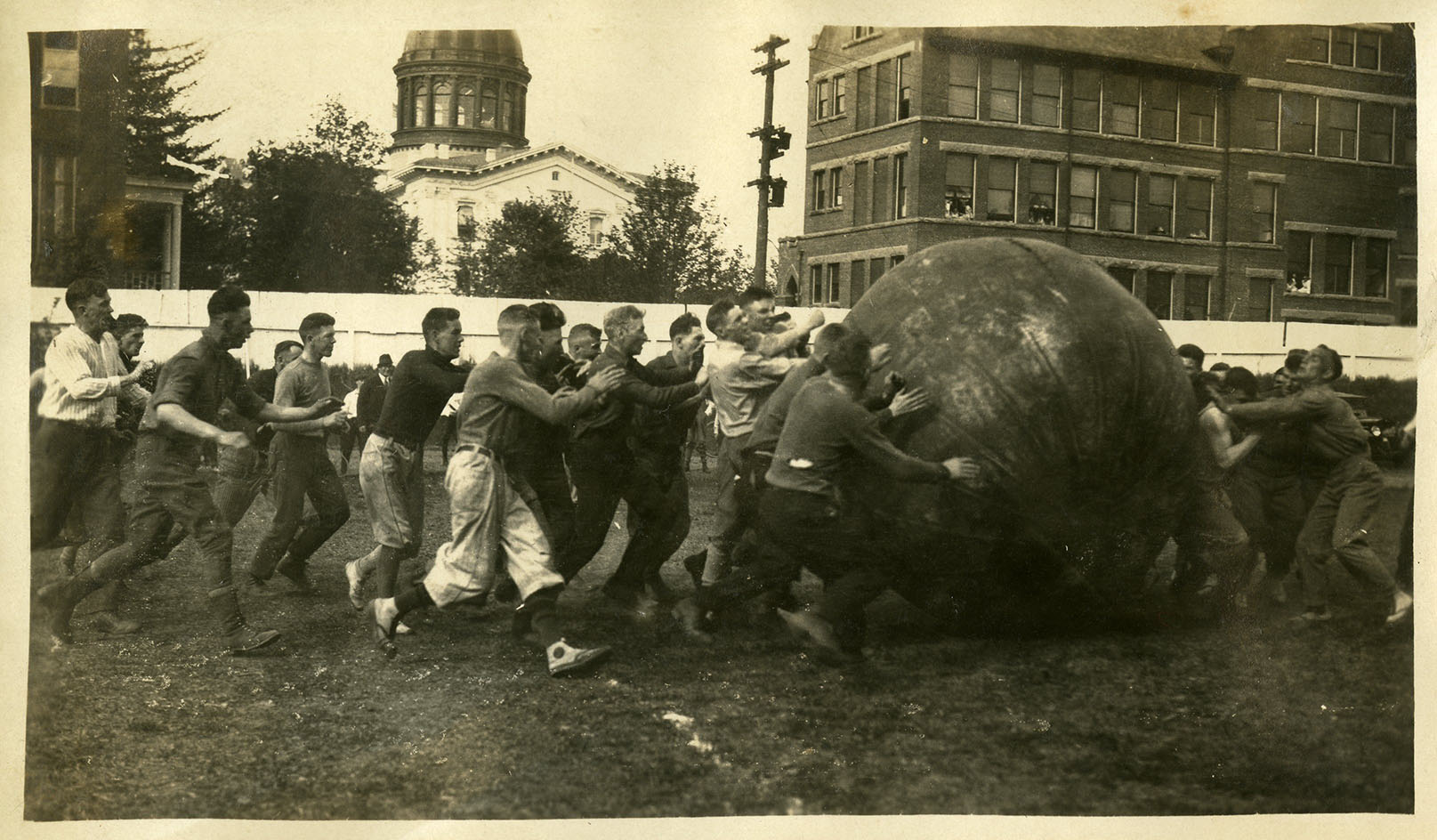
After the cancellation of the annual Bag Rush in 1944, Willamette students were missing that old show of rivalry— a lively, engaging way to demonstrate school spirit and raise morale for the football team during Homecoming. To fill the void, Push-Ball was introduced. Beginning as a May Weekend tradition in 1920,22 it became a part of the Homecoming festivities in 1946.23
The contest was, unsurprisingly, a competition between freshmen and sophomores, in which each team would attempt to push an eight-foot-tall, rubberized leather ball across the football field.24 The first team to bring the ball to their side of the field was the winner. While the game was added to provide a new way to participate in Homecoming, it was only open to men, as women were not permitted to compete. Counterintuitively, although the game was intended replace the dangerous Bag Rush, it lacked any rules regarding violence. Freshmen and sophomores were free to push and fight their way to victory by whatever means necessary.25
According to Homecoming editions of the Collegian, this game was highly anticipated and beloved by students,26 making it unclear why it was discontinued after 1954. Possibly, the game was cancelled due to decreased participation in Homecoming and school-sponsored events overall. Regardless, the joviality and absurdity of this short-lived game remain a clear demonstration of the fun-loving, creative community that called Willamette University home.
Ugly Man Contest
Most are familiar with Willamette’s long-running tradition of a May Weekend celebration, in which a may queen would be crowned by popular vote, based on evident beauty and grace. In contrast, the “Ugly Man Contest’ began Homecoming in 1948.27 This event invited women to vote for the male student they deemed the least conventionally attractive. Rules for this competition were scarce, though a 1950 issue of the Collegian stated “Dogs, President Smith, and Dean Hatfield [were] not eligible” for entry.28 While the contest focused on the public ranking of male students based on appearance, it also functioned as a fundraising event. These sorority-sponsored events raised money for campus improvements and charitable causes. The first two raised money for a flagpole memorial for Willamette students who were casualties of war.29 In 1961 the proceeds supported a drive for muscular dystrophy30 and in 1964 the funds were donated to the American Cancer Society.
After its creation in 1948, the Ugly Man Contest became an annual Homecoming tradition, although it transitioned to the Associated Women Students Carnival in the early 1960’s. It is unclear exactly when the event ceased to be celebrated on campus, although references to it declined in the early 1960s.31 That said, the event was likely a source of controversy—for obvious reasons—and it’s possible that the Ugly Man Contest became, much like its participants, unfashionable.
***
Homecoming was one of Willamette’s longest-standing traditions. The last official Homecoming celebration took place in 2018, nearly a century after the first in 1923. Although most Homecoming traditions and competitions ceased after the 1970s, these contests were a defining part of student life and a festive way to release underlying tensions. Although Homecoming football games remain a cause for excitement, the beard-growing, leaf-raking, and class-rivalry competitions of years past have faded from the Willamette experience.
Endnotes
Click to expand
- “Frosh Win Bag Rush.” Willamette Collegian, 4 November, 1914, 1. https://hdl.handle.net/10177/10615. ↩︎
- “Bag-Rush to be Between Halves of Game.” Willamette Collegian, 17 October, 1923, 1. https://hdl.handle.net/10177/9338. ↩︎
- Ibid. ↩︎
- “Parkin Bag Rush Casualty.” Willamette Collegian, 22 September, 1944, 3. https://hdl.handle.net/10177/10626. ↩︎
- “‘Lo, Our Cash Dies as Sparks Mount Upward.’” Willamette Collegian, 22 November, 1922, 1. https://hdl.handle.net/10177/7852. ↩︎
- “Rally and Bonfire are Events Tonight.” Willamette Collegian, 7 November, 1923, 1. https://hdl.handle.net/10177/8193. ↩︎
- Ibid. ↩︎
- “44th Homecoming Revises Old Traditions.” Willamette Collegian, 5 November, 1965, 2. https://hdl.handle.net/10177/9395. ↩︎
- “Homecoming Abolished; Limited Activities Scheduled.” Willamette Collegian, 13 October, 1970, 3. https://hdl.handle.net/10177/8549. ↩︎
- “WU Activities Board Meets.” Willamette Collegian, 27 October, 1970, 3. https://hdl.handle.net/10177/8779. ↩︎
- “Frosh Win Right to Discard Colors.” Willamette Collegian, 5 November, 1931, 1. https://hdl.handle.net/10177/7582. ↩︎
- “Frosh Rake Leaves Early Friday Morning.” Willamette Collegian, 18 November, 1932, 1. https://hdl.handle.net/10177/10547. ↩︎
- “Campus Competition Keynotes 32nd Homecoming Celebration.” Willamette Collegian, 23 October, 1953, 1. https://hdl.handle.net/10177/9731. ↩︎
- Ibid. ↩︎
- “Whisker Contest to be Sponsored.” Willamette Collegian, 20 January, 1939, 1. https://hdl.handle.net/10177/9269. ↩︎
- “Spirit and the Student Council.” Willamette Collegian, 2 October, 1953, 2. https://hdl.handle.net/10177/7791. ↩︎
- “WU Males to Sprout Whiskers for Freshman Glee Competition.” Willamette Collegian, 30 January, 1948, 1. https://hdl.handle.net/10177/7456. ↩︎
- “Whisker Contest to be Sponsored.” Willamette Collegian, 20 January, 1939, 1. https://hdl.handle.net/10177/9269. ↩︎
- “Campus Men Groom Beards for Homecoming; Ugly Man Candidate Selection up to Women.” Willamette Collegian, 9 October, 1953, 1. https://hdl.handle.net/10177/9544. ↩︎
- “Prizes Awarded at Sock Hop.” Willamette Collegian, 30 October, 1953, 6. https://hdl.handle.net/10177/8961. ↩︎
- “Spirit and the Student Council.” Willamette Collegian, 2 October, 1953, 2. https://hdl.handle.net/10177/7791. ↩︎
- “Freshmen Win in May Frolics.” Willamette Collegian, 13 May, 1920, 4. https://hdl.handle.net/10177/9392. ↩︎
- “Signs Judged Today; Parade Forms at 6:40.” Willamette Collegian, 25 October, 1946, 3. https://hdl.handle.net/10177/7767. ↩︎
- Ibid. ↩︎
- “Freshmen Win in May Frolics.” Willamette Collegian, 13 May, 1920, 4. https://hdl.handle.net/10177/9392. ↩︎
- “Push-ball and Freshmen Glee Prospects Excite Rookies Most.” Willamette Collegian, 30 September, 1949, 7. https://hdl.handle.net/10177/8680. ↩︎
- “Homecoming Reaches Quarter-Century Mark.” Willamette Collegian, 22 October, 1948, 3. https://hdl.handle.net/10177/8856. ↩︎
- “McCulloch Stadium, Game with Hawaii U. Features of 27th Annual Homecoming.” Willamette Collegian, 22 September, 1950, 1. https://hdl.handle.net/10177/10567. ↩︎
- “Homecoming Slogan Theme of Weekend.” Willamette Collegian, 8 October, 1948, 1. https://hdl.handle.net/10177/8616. ↩︎
- “Board Eyes Cost Boost for Activities.” Willamette Collegian, 20 October, 1961, 3. https://hdl.handle.net/10177/8458. ↩︎
- “Ugly Man Named at AWS Carnival.” Willamette Collegian, 13 March, 1964, 4. https://hdl.handle.net/10177/7501. ↩︎
Image Citations
Click to expand
- “Freshman Bonfire, circa 1925,” Campus Photograph Collection, WUA9999, Willamette University Archives and Special Collections.
- “Marion Barnes Class of 1920, 1960-1920,” Series IV, Box 24. Willamette University Scrapbook Collection, WUA048, Willamette University Archives and Special Collections.
- “Person Standing in Chariot, early 1920s,” Series I, Box 2. Vernor Martin Sackett Negatives Collection, WUA044. Willamette University and Archives Special Collections.
- “Whiskerino Left to Students,” Willamette Collegian, 2 October, 1953, 3. https://hdl.handle.net/10177/7791.
- “Photograph Scrapbook, Circa 1920.” Series IV, Box 46. Willamette University Scrapbook Collection, WUA048. Willamette University Archives and Special Collections.