
Written by Lilly Thies, Class of 2026
Many students are aware that Methodist missionaries founded the Salem landmarks of the Methodist Episcopal Church in 1841, and Willamette University in 1842. But fewer know that where the modern building Ford Hall stands now, for thirty-five years, there was once the Kimball School of Theology, a pioneering institution in the history of the Methodist church in the Northwest.
The Kimball College of Theology was conceptualized by Reverend Henry D. Kimball, D.D., who came from the East coast in 1902 to Spokane, Washington where he was stationed at St. Vincent Church. Upon his arrival, he “was impressed with the need for a school for theological study in this great Northwest… west of the Rockies and north of California there was no such provision in the Methodist Church.”1 Kimball’s path was paved by Reverend John Dempster (1794-1863), the “father of theological schools in the Methodist Church,”2 who had come up with a plan for a school in the Northwest region, but unfortunately died before his dream could be realized. John H. Coleman, the president of Willamette from 1902-1908, reached out to Kimball and offered him space on the campus for the theological school to be built. The issue of funding was resolved by Kimball’s very generous wife, Luella, who donated 20,000 dollars of her own fortune to allow the building to be constructed.3 With the funds raised, the trustees of Willamette met in Portland on January 31, 1906, where they organized the school, named it Kimball College of Theology, and elected Dr. Kimball as dean.4 Kimball worked as the school’s dean for eight years, for which “he received not one cent of salary. On the other hand both he and Mrs Kimball constantly drew on their private resources for furthering the interests of the school.”5 In September of 1914, Kimball felt it necessary to resign on account of failing health, and he died in Pasadena, California, in June of 1915. He was succeeded by Reverend H.J. Talbott.

According to a copy of the Collegian announcing the opening of Kimball College, the purpose of the new school was “to assist young men who seem to themselves and to the Church to be called by God to the Christian ministry to qualify themselves spiritually and intellectually for their great work… Those of either sex who, while not contemplating the work of the ministry, desire to fit themselves for larger usefulness in Christian work will be admitted to all class privileges upon the same terms as candidates for the ministry.”6 Although women could not enter the ministry, they could study alongside men and achieve the same degree upon completion of their study.
Kimball College of Theology was originally a department of Willamette under John Coleman’s tenure. However, soon after the school’s founding, it became evident that a separate administration would be preferable. There were various reasons for the parting, but it was mainly cited that “university trustees did not feel prepared to assume financial responsibility for the maintenance of the school of theology,” as the school served “the entire states of Oregon, Washington, Idaho and Montana,” which would have been a great additional responsibility for the existing University administration to take on.7 On September 4th, 1907, the school became its own entity with its own board of trustees. Despite this bureaucratic separation, the school maintained cooperative relations with the University, and students were able to participate in an exchange program– “Willamette gave credit for approximately 30 hours of religion taken at Kimball school.”8 Kimball students were allowed to take a few classes at Willamette in exchange, and had access to the University’s gymnasium and library. Kimball students remained closely interwoven socially with students of Willamette, as they shared the same campus.
Kimball enrolled upwards of sixty students in the first five years since its founding, and graduated its first class of eleven graduates in 1910.9 Four of those students, who were already college graduates, received the special degree of “Bachelor of Divinity” offered by Kimball, while the other seven received undergraduate degrees according to their chosen course of study. Later in the school’s history, a bulletin for the school dating from the 1929-1930 school year outlines the two degrees that were available at that time for students: the Bachelor of Divinity, a postgraduate degree consisting of three years of instruction, ninety-six institution credits, and a 5,000 word thesis, as well as a Masters of Arts in Religious Education, which took a single year, required thirty-two credits, and also culminated in a written thesis.10 Over the course of its twenty-four year tenure on Willamette’s campus, Kimball graduated seventy-five students, most of whom went on to have positions in the theological field.11
In 1918, the name of Kimball College of Theology was changed to Kimball School of Theology at the request of the Methodist church, which wanted to bring uniformity to the church’s various educational institutions and distinguish them from colleges of the liberal arts. The school was one of five accredited theological seminaries of the Methodist Episcopal Church at the time, and as such was required to adhere to Methodist teachings and policies. The faculty, who were required to be of Methodist faith, were all to be approved by the bishop presiding over the area.12
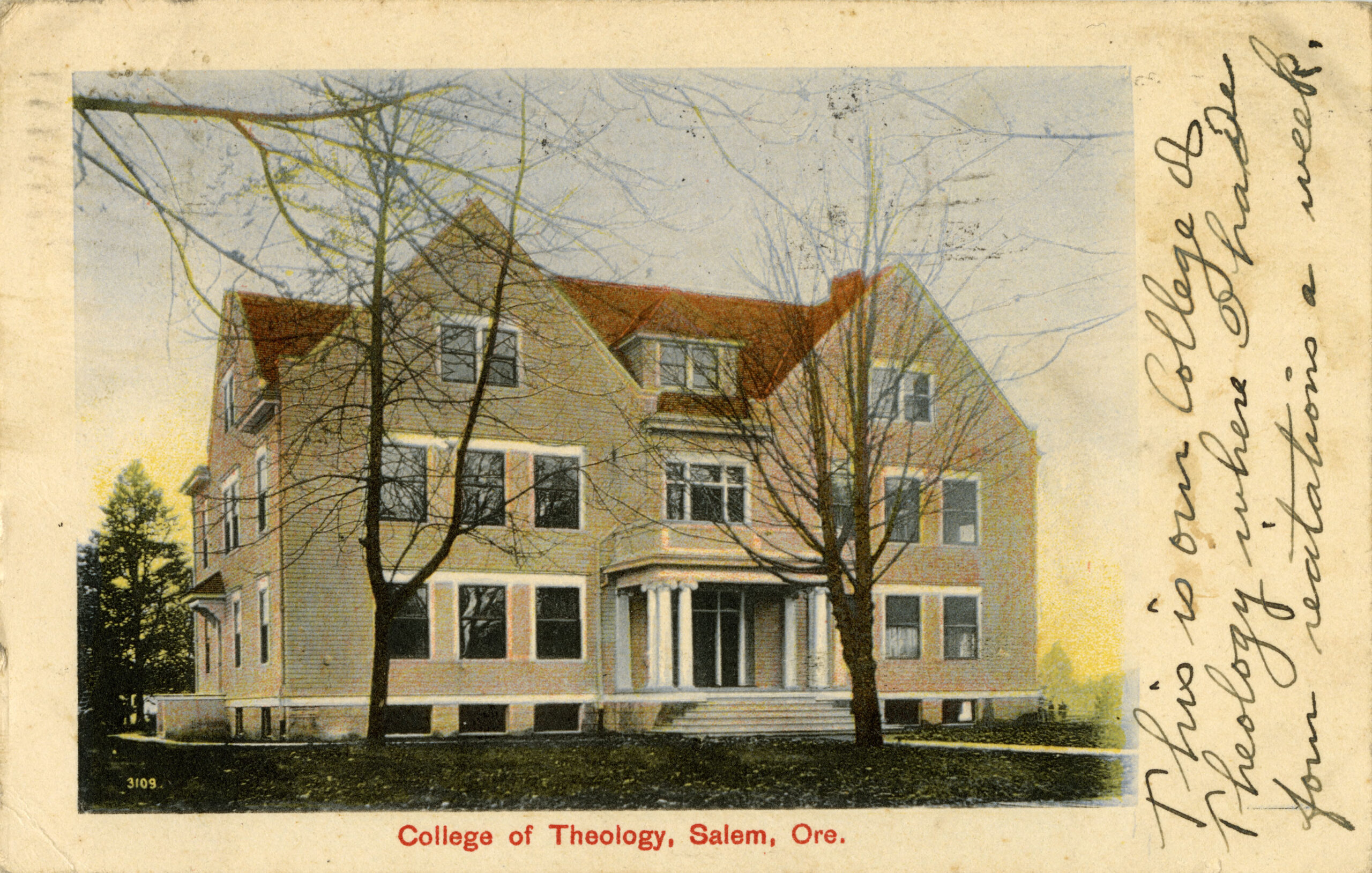
The Kimball College of Theology building, funded by Mrs. Luella D. Kimball, was ““Fifty-four feet by eighty-six feet, with a basement, and two stories and a half,” with ample room to “accommodate several hundred students,”13 It was lighted with electricity, heated by furnaces, and featured a chapel that could seat over two hundred people.14 Later, in the 1920s and 1930s, the building was installed with “dormitory, study, social and rest rooms, shower bath; also kitchen for those who desire to do their own cooking.”15 It was also outfitted with a library, which was “devoted to the collection of materials bearing directly upon the religious, theological, biblical, religious education, and missionary fields.”16


Kimball offered a wide range of classes in eight different departments, ranging from geography to close reading of scripture to classes in Hebrew and Greek. Some of the most intriguing in the catalog include the Geography of Palestine, which concerned “not only with the localities of the Holy land, but with the historical events associated with them.”17 Christian Evidences was “a study of present day objections” to Christianity and “the grounds for a belief in the existence of God.”18 History of Social Christianity examined “phases of general history of extreme value to any worker who desires a comprehensive grasp of his own day, and the problems he must face in his task.”19 Other classes included Canon and Text of Scripture, Hermeneutics, Old and New Testament History, the Life of Christ, Church History, History of Methodism, History of Doctrine, Comparative Religions, Psychology of Religion, Systematic Theology, and English, Greek, and Hebrew Exegesis.20 The college also offered courses for those who wanted to go into religious education, such as Religious Pedagogy and Rural Leadership. In their free time, Kimball students were able to participate in the Glee club, which was organized in 1921,21 and many played volleyball on the school’s north lawn.22
Unfortunately, due to a lack of financial support for the school’s ongoing operation, Kimball School of Theology closed their doors in 1930,23 and the Religious Studies department at Willamette was established to fill the gaps in theological education that would be left by the dissolution of Kimball. The building itself, renamed as Kimball Hall, was then used to house the music and art departments24 until they moved into newer and remodeled buildings in the fall of 1941. Kimball Hall, called an “eye-sore”25 by some impassioned students, was demolished in the summer of 1942, with plans calling for “filling in the basement, leveling the ground, and planting lawn and shrubs”26 immediately following the building’s removal.
Although the building and its program no longer exists today, Willamette still has a small but mighty religious studies department, where students can take classes such as Religion in America, Paganism in Ancient Greece and Rome, Race and Religion, Religions of Asia, Introduction to Islam. The original Methodist Episcopal Church of Salem is now represented by The First United Methodist Church, whose original 1878 building stands on the corner of Church and State Street.27
Endnotes
Click to expand
- “Kimball School of Theology Edition,” Willamette Collegian, 12 March 1919, 2, https://hdl.handle.net/10177/8198.
- “Theology Edition,” 3.
- “Building and Endowment for Willamette,” Willamette Collegian, 13 March 1907, 5, https://hdl.handle.net/10177/7651.
- “Theology Edition,” 3.
- “Theology Edition,” 2.
- “Dedicate College,” Willamette Collegian, 3 October 1906, 4, https://hdl.handle.net/10177/9390.
- “The Bulletin,” Willamette University, 1929-1930, 18, https://hdl.handle.net/10177/12023.
- “Last Days of Kimball Hall Brings Historic Survey of Romantic Structure.” Willamette Collegian, 2 June 1938, 1, https://hdl.handle.net/10177/8485.
- “The College of Theology: Wherefore and What?” Willamette Collegian, 7 April 1911, 2, https://hdl.handle.net/10177/9261.
- “Bulletin,” 18.
- “Last Days,” 1.
- “Theology Edition,” 2.
- “Dedicate College,” 1.
- Wallulah 1906, Willamette University Digital Collections, Wallulah (Student Yearbook,) 1906, 12, https://hdl.handle.net/10177/11858. Accessed November 11, 2025.
- “Bulletin,” 15.
- Ibid.
- “Theology Edition,” 1.
- Ibid.
- Ibid.
- Ibid.
- Wallulah 1922, Willamette University Digital Collections, Wallulah (Student Yearbook,) 1922, 96, https://hdl.handle.net/10177/11860. Accessed November 11, 2025.
- “Kimball Will Improve Volleyball Facilities,” Willamette Collegian, 1 March 1928, 4, https://hdl.handle.net/10177/8294.
- Susan Gibby, “Willamette University,” Willamette Heritage Center, 24 August 2005, https://www.willametteheritage.org/willamette-university/. Accessed 13 November 2025.
- “Last Days,” 1.
- “At Long Last– Kimball Hall Making Exit From Campus,” Willamette Collegian, 19 June 1942, 3, https://hdl.handle.net/10177/8332.
- Ibid.
- “Our History,” First United Methodist Church of Salem, https://www.salemfirstumc.org/history.
Works Referenced
Click to expand
- “At Long Last– Kimball Hall Making Exit From Campus.” Willamette Collegian, 19 June 1942, 3. https://hdl.handle.net/10177/8332. “Our History.” First United Methodist Church of Salem. https://www.salemfirstumc.org/history.
- “Building and Endowment for Willamette.” Willamette Collegian, 13 March 1907, 5. https://hdl.handle.net/10177/7651.
- “The Bulletin.” Willamette University, 1929-1930, 18. https://hdl.handle.net/10177/12023.
- “Dedicate College.” Willamette Collegian, 3 October 1906, 4. https://hdl.handle.net/10177/9390.
- Gibby, Susan. “Willamette University.” Willamette Heritage Center, 24 August 2005, https://www.willametteheritage.org/willamette-university/. Accessed 13 November 2025.
- “Kimball School of Theology Edition.” Willamette Collegian, 12 March 1919, 1-2. https://hdl.handle.net/10177/8198.
- “Kimball Will Improve Volleyball Facilities.” Willamette Collegian, 1 March 1928, 4. https://hdl.handle.net/10177/8294.
- “Last Days of Kimball Hall Brings Historic Survey of Romantic Structure.” Willamette Collegian, 2 June 1938, 1. https://hdl.handle.net/10177/8485.
- “Our History.” First United Methodist Church of Salem. https://www.salemfirstumc.org/history.
- “The College of Theology: Wherefore and What?” Willamette Collegian, 7 April 1911, 2. https://hdl.handle.net/10177/9261.
- Wallulah 1906. Willamette University Digital Collections, Wallulah (Student Yearbook,) 1906, https://hdl.handle.net/10177/11858. Accessed November 11, 2025.
- Wallulah 1922. Willamette University Digital Collections, Wallulah (Student Yearbook,) 1922, https://hdl.handle.net/10177/11860. Accessed November 11, 2025.
Image Citations
Click to expand
- All images from “The Bulletin,” Willamette University, 1929-1930, 18, https://hdl.handle.net/10177/12023.