
Written by Lilly Thies, Class of 2026
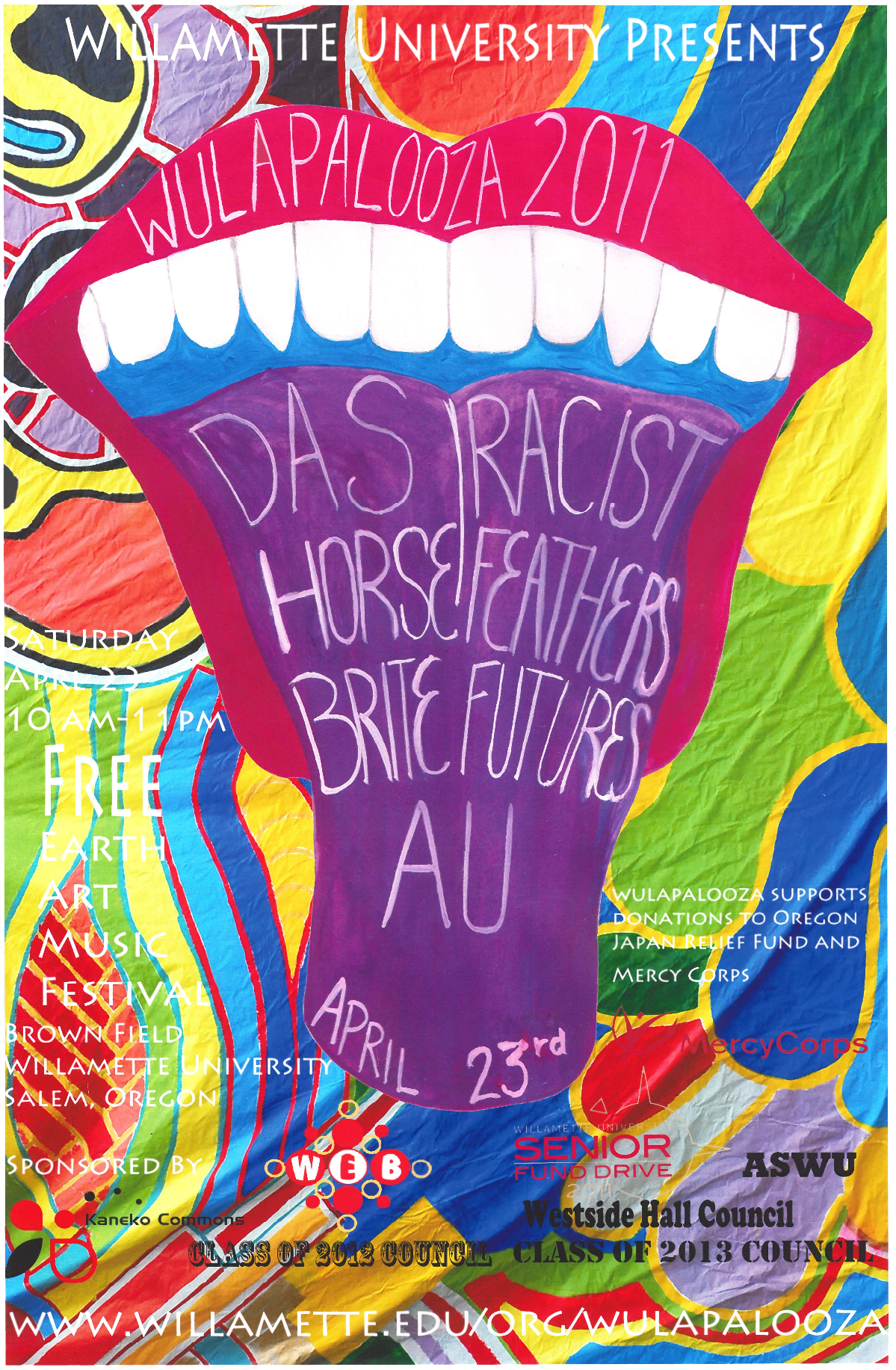
Wulapalooza, Willamette’s Earth, Art, and Music festival, was a hallmark of student life from its conception in 1998 to its last show twenty years later in 2018. In the first week of May, students, momentarily freed from studying for exams, would stream out onto Brown Field to bask in the spring sunshine. The rhythmic pounding of Taiko drums signaled the beginning of the event which continued into the evening. The Willamette community, bedecked in homemade tie-dye and face paint, could dance the night away, showcase their art or musical prowess, and forget about their impending finals week.
Undergrads Eben Dickinson BA ‘00 and Jed Jorgensen BA‘00, who were musicians in a student band called Nimblefoot, noted a lack of events for music and the arts on campus. According to the Collegian’s twenty-year retrospective of the event,“hoping to tap into unused hall funds, the members wanted to sponsor an event that would showcase the group’s talent to the campus and community,” and the festival thereafter “blossomed from a single show to a campus-wide celebration of art, music, and community.”1 Wulapalooza, which was originally called The Brown Get Down “because of the event’s location on Brown field,” was renamed to stand for “Willamette University Liberal Arts Palooza.”2 The inaugural festival, which took place on May 2nd, 1998, featured performances of student bands from 1-7 pm, and aimed to raise money for a campus sound system– which would later become ASWU Sound– to allow student bands to give concerts on campus more easily. To raise funds, the organizers reached out to local businesses for sponsorships in return for advertisements.3 Eventually, Wulapalooza became an annual event and the highlight of the Spring semester for many.

Wulapalooza was an entirely student-run and coordinated event, with campus staff only stepping in to provide support with negotiating contracts and pricing for hiring non-student bands as well as making sure festival plans complied with Campus Safety policies. The event was the sole responsibility of the Wulapalooza club, which met weekly throughout the school year to coordinate and plan.4 The event could not take place without student volunteers, both on stage and behind the scenes– calls for auditions and volunteer sign ups were posted in the Collegian throughout the beginning of spring semester. Eventually, into the 2010s, the club would put on additional smaller music festivals throughout the year to showcase student bands and acapella groups, such as the aptly named Fallapalooza, which was described as “a wintry, small-scale version of Wulapalooza,5 and Schoolapalooza, a similar back-to-school music event.

The featured events of Wulapalooza varied over the years, but the structure remained generally the same. During the day, student performers would take to the stages set up in Jackson Plaza and Brown field and play 15 minute sets. Featured professional groups would perform in the evening portion of the event. As the festival received more money from ASWU and outside fundraising, they were able to include well-known bands such as Portugal. The Man, and Kishi Bashi. The Wulapalooza committee usually attempted to seek out bands “based on the desired atmosphere of the event,” but hip-hop bands were “usually not considered because of Wulapalooza’s close proximity to the Hip Hop Congress [another Willamette club]’ Conscious Overdose concert.”6 In 2015, the Collegian reported that the festival would “cost the University $30,450… $18000 will go to the bands. About 10,000 will be used to rent, assemble and run the sound equipment for the day.”7 The larger budget allowed for many fun activities other than just musical performances, including “face and body painting, kittens, bubbles, cotton candy, slip-and-slides, bike-powered smoothies, rubber duck races, DIY tie-dye and many more.”8 Over the years, the festival also hosted a student art show and a craft fair where students could sell items they made. Bon Appetit, the university’s food service provider, often sponsored a Beer Garden where students over 21 could try local microbrews.9 In later years, various clubs and organizations would time their events to coincide with Wulapalooza, such as the release of the literary magazine Chrysalis and the crowning of the intramural sports champions.

Many organizations participating in Wulapalooza contributed to charitable causes, such as Phi Delta Theta’s Mill Stream rubber duck race to raise money for ALS research, or a Locks of Love booth to encourage donations of hair to make wigs for cancer patients.10 Wulapalooza also eventually absorbed the previously established Earth Day celebrations, inspiring their slogan “Earth, Art and Music.”11 Efforts to increase the eco-friendly aspect of Wulapalooza in 2012 included bicycle taxi services and pedal-power smoothie-making from Willamette’s Bike Club, as well as an area for arts & crafts where students could make “a reusable grocery bag made out of an old t-shirt… a group sculpture from found materials, or tie-dye a handkerchief that replaces paper towels.”12 In 2003, the festival’s organizers brought in a speaker to discuss the environmental issues caused by war, as a response to the US deployment of troops to Afghanistan.13
As the festival grew in size and popularity, it also gained notoriety as an event where students would participate in drinking and drug activity. To curb safety issues caused by substance abuse, in 2016, Campus Safety implemented new rules for the festival, including “a single event entrance, requiring that all water bottles brought be transparent and emptied before being brought into the festival area, bags being subject to search upon entry and no tents (or any enclosed structures) being allowed on festival grounds.”14 Despite the relative severity of this change in comparison to previous years, these regulations were not unexpected. Teddy Wu, the president of Wulapalooza club at the time, stated that “[2015’s] Wulapalooza counted five hospitalizations as well as several cases of vandalism and biohazard issues throughout campus,” likely as a result of drunken revelry. Campus Safety Director Ross Stout also said that “he observed over the past two or three years an escalation in the quantity of marijuana and alcohol consumed at that event.”15 These new rules sparked concern among students, who questioned whether those who were planning to abuse drugs and alcohol at the event would be stopped by the new policies. Ethan Coffey, who wrote a guest column for the Collegian on the matter, said that he had “heard multiple people say something along the lines of ‘well, I’ll just get really drunk beforehand, then,”16 leading him to believe that students would still partake in unsafe alcohol and drug use, but in a less safe environment. He pointed out that Wulapalooza grounds were monitored by campus safety and students had no-questions-asked access to medical assistance at a designated tent. According to the Collegian, “The conflicts, safety concerns, and disagreements escalated to the point that it became difficult for students to freely organize and control the event, forcing Wulapalooza to shut down.”17
Despite the end of Wulapalooza as a yearly tradition, music events continue at Willamette. Students today can attend the regular house shows hosted by local bands and student groups, and the Bistro is often converted into a venue for Jazz combos to showcase their talent, or for students to take the stage at an Open Mic. In 2022, a group of students even received a CAFES grant to put on their own iteration of a Willamette music festival, which they called Musicália. These events would not be possible without the ASWU Sound equipment that Jorgensen and Dickinson originally established Wulapalooza to fund, and so the legacy of the beloved festival lives on.
Endnotes
Click to expand
- Autumn Bracamonte, “Wulapalooza celebrates campus culture,” Willamette Collegian, 13 March 1998, 3, https://digitalcollections.willamette.edu/items/abb89da9-a0df-4fba-a07a-19e5f60b9f2a.
- Amy Hagelin, “Wulapalooza celebrates 10 years of Earth, Art and Music,” Willamete Collegian, 23 April 2008, 7, https://hdl.handle.net/10177/7421.
- Bracamonte, “Campus Culture,” 3.
- Eli Kerry, “WU community prepares for 19th annual Wula,” Willamette Collegian, 26 April 2017, 2, https://digitalcollections.willamette.edu/items/270d7b9d-8b1e-4813-8fec-8a2bb22165d1.
- Elize Manoukian and Andrea Risolo, “Get Unlucky at Fallapalooza,” Willamette Collegian, 13 November 2015, 6, https://digitalcollections.willamette.edu/items/c4acf8d9-f136-4923-beec-a7754f989c8b.
- Hagelin, “10 years,” 7.
- Joseph Lindblom-Masuwale, “$30k funded for Wulapalooza,” Willamette Collegian, 4 February 2015, 2, https://digitalcollections.willamette.edu/items/85f0665f-8816-4a40-9bee-be4571ad40c9.
- Kerry, “19th Annual Wula,” 2.
- Ariel Osborne, “Wulapalooza,” Willamette Collegian, 18 April 2012, 6-7, https://digitalcollections.willamette.edu/items/2d2f83d0-c371-4dbf-ac81-17a83e0d4b22.
- “Hair Donation Event Scheduled for Wulapalooza.” Willamette Collegian. 16 March 2005, 5. https://digitalcollections.willamette.edu/items/5b81eff0-d22f-44f5-a73c-c5cd58733fd7.
- Osborne, “Wulapalooza,” 6.
- Ibid., 7.
- Allison Ervine, “Wulapalooza approaches,” Willamette Collegian, 9 April 2003, 3, https://digitalcollections.willamette.edu/items/4a8d1c06-8521-4d5e-a1a6-b719d080cc04.
- Ryan Gail, “WULA Regulations cause controversy among students,” Willamette Collegian, 21 April 2016, 2, https://digitalcollections.willamette.edu/items/9f6079b6-d77d-4142-8070-9e560327143c.
- Ibid.
- Ethan Coffey, “New Wula rules promote binge drinking and prejudice,” Willamette Collegian, 14 April 2016, 11, https://digitalcollections.willamette.edu/items/038627ef-8d6d-4baf-a8d0-eb36c7ad77c1.
- Maya Darski, “The legend of Wulapalooza: How Willamette’s once renowned music festival lived and died,” Willamette Collegian, 26 February 2025, https://www.willamettecollegian.com/post/the-legend-of-wulapalooza-how-willamette-s-once-renowned-music-festival-lived-and-died.
Works Referenced
Click to expand
- Bracamonte, Autumn. “Wulapalooza celebrates campus culture.” Willamette Collegian, 13 March 1998, 3. https://digitalcollections.willamette.edu/items/abb89da9-a0df-4fba-a07a-19e5f60b9f2a.
- Coffey, Ethan. “New Wula rules promote binge drinking and prejudice.” Willamette Collegian, 14 April 2016, 11. https://digitalcollections.willamette.edu/items/038627ef-8d6d-4baf-a8d0-eb36c7ad77c1.
- Darski, Maya. “The legend of Wulapalooza: How Willamette’s once renowned music festival lived and died.” Willamette Collegian, 26 February 2025. https://www.willamettecollegian.com/post/the-legend-of-wulapalooza-how-willamette-s-once-renowned-music-festival-lived-and-died.
- Ervine, Allison. “Wulapalooza approaches.” Willamette Collegian, 9 April 2003, 3. https://digitalcollections.willamette.edu/items/4a8d1c06-8521-4d5e-a1a6-b719d080cc04.
- Gail, Ryan. “WULA Regulations cause controversy among students.” Willamette Collegian, 21 April 2016, 2. https://digitalcollections.willamette.edu/items/9f6079b6-d77d-4142-8070-9e560327143c.
- Hagelin, Amy. “Wulapalooza celebrates 10 years of Earth, Art and Music.” Willamete Collegian, 23 April 2008, 7. https://hdl.handle.net/10177/7421.
- “Hair Donation Event Scheduled for Wulapalooza.” Willamette Collegian. 16 March 2005, 5. https://digitalcollections.willamette.edu/items/5b81eff0-d22f-44f5-a73c-c5cd58733fd7.
- Kerry, Eli. “WU Community prepares for 19th annual Wula.” Willamette Collegian, 26 April 2017, 2. https://digitalcollections.willamette.edu/items/270d7b9d-8b1e-4813-8fec-8a2bb22165d1.
- Lindblom-Masuwale, Joseph. “$30k funded for Wulapalooza.” Willamette Collegian, 4 February 2015, 2. https://digitalcollections.willamette.edu/items/85f0665f-8816-4a40-9bee-be4571ad40c9.
- Manoukian, Elize, and Andrea Risolo. “Get Unlucky at Fallapalooza.” Willamette Collegian, 13 November 2015, 6. https://digitalcollections.willamette.edu/items/c4acf8d9-f136-4923-beec-a7754f989c8b.
- Osborne, Ariel. “Wulapalooza.” Willamette Collegian, 18 April 2012, 6. https://digitalcollections.willamette.edu/items/2d2f83d0-c371-4dbf-ac81-17a83e0d4b22.
Image Citations
Click to expand
- Poster, Wulapalooza, 2007. Box 56, Willamette University Office of Student Activities records, WUA054. Willamette University Archives and Special Collections.
- Call for Artists Poster, Wulapalooza, 2001. Box 56, Willamette University Office of Student Activities records, WUA054. Willamette University Archives and Special Collections.
- Poster, Wulapalooza, 2010. Box 56, Willamette University Office of Student Activities records, WUA054. Willamette University Archives and Special Collections.